I write this mini-essay to capture a snap-shot of my mind as a 28 year old man. This is my solution to deal with the following problems:
- Mobility and Functional impairment: Multiple Sclerosis, limb loss, paralytic conditions etc
- Algic impairment: Hemophilia, Sciatica, Cancer (?), Endometriosis etc
- Bereavement: loss of a child/pet/partner/parent etc
- Losing money/sanity/respect/dignity
- An evil-spirit stole your balls while exploring a haunted underpass
First, don't try to hunt for unique solutions to the above problems. Treat them all as one general class of suffering. Most humans will naturally converge on the "Cycle of acceptance" model after periods of prolonged suffering:
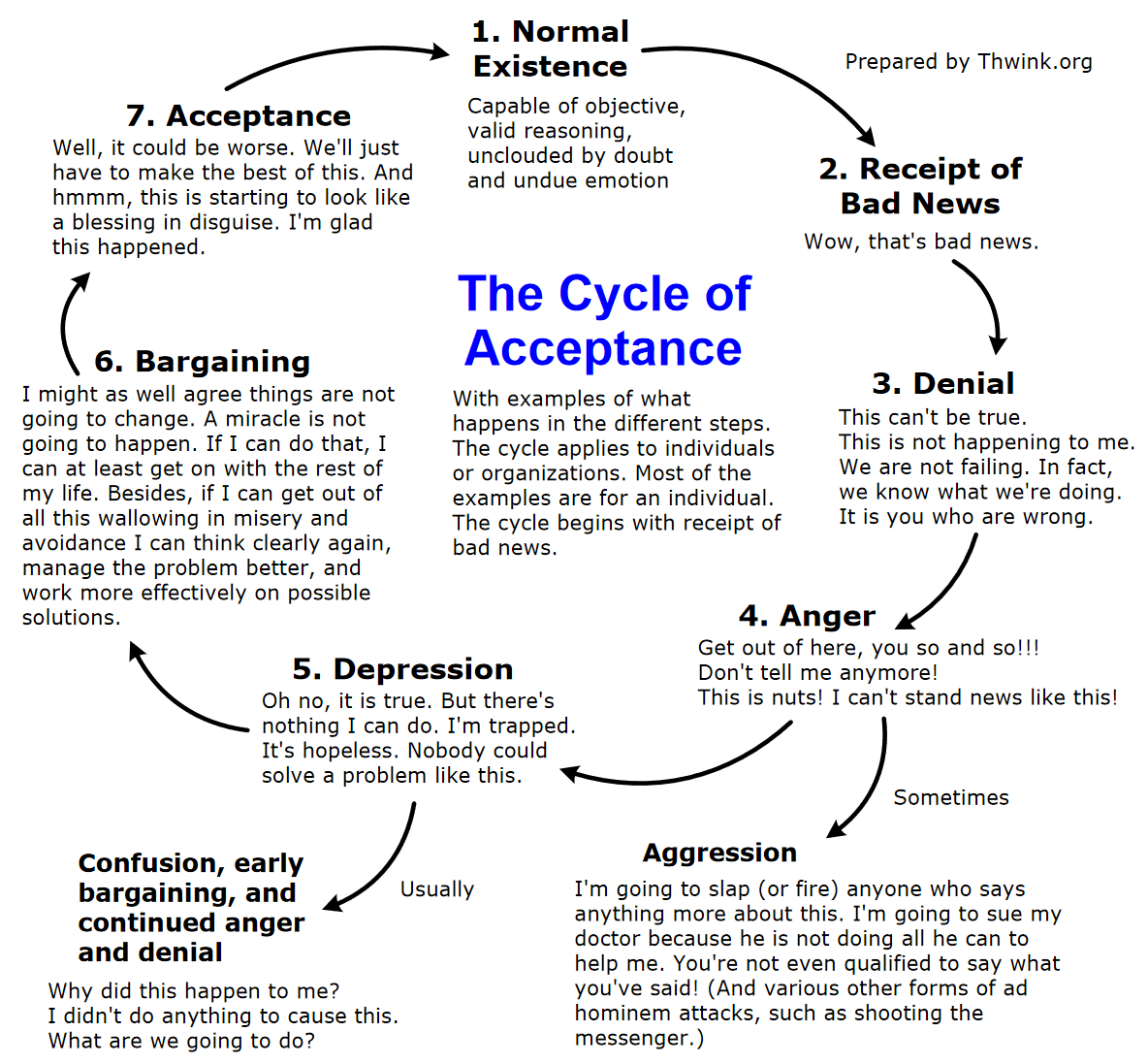
source
I've found the following optimizations to tighten the loop:
My solution:
- On a piece of paper, write down the raw truth of your tragedy and put it up on a wall where you will see it daily. For example: "X has passed away. X is not coming back. There is nothing else to do". You want to accept your reality as soon as possible. Rip that band-aid off.
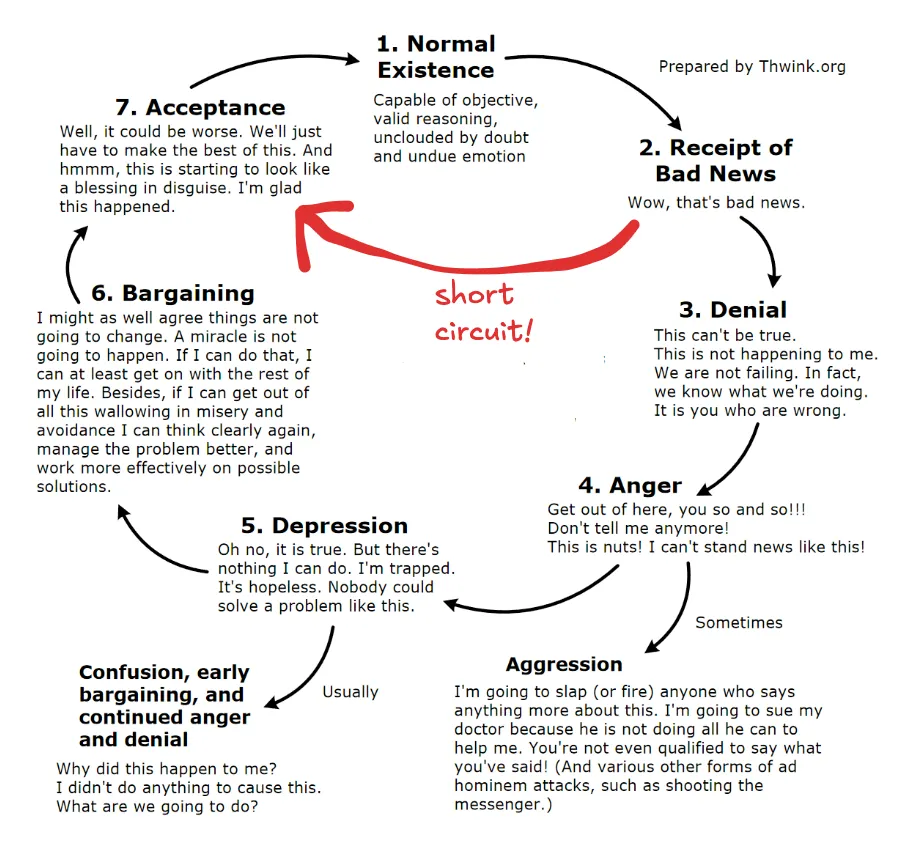
Note that acceptance of a tragic reality should NOT be misinterpreted as acceptance of pain/suffering as a new normal. You can always attempt to minimize it. For example if your condition is algogenic, you seek prescriptions for pain-killers.
- Remind yourself that you are not the only one going through this tragedy. No matter how unique you may think your tragedy is, trust me there are people who have experienced it. Hop on the internet and find support groups/forums. Reddit is a great place to start.
By doing this, you get to speed run the following stages -> 3. Denial, 4. Anger, 5. Depression and 6. Bargaining. Under the hood, your brain is going to vicariously experience these stages and speed up the re-construction of your world model. I think of empathy as a copy-paste mechanism for human experience so you get to experience hundreds of paths from your current tragic state to a new normal. This, in my personal experience, speeds up acceptance.
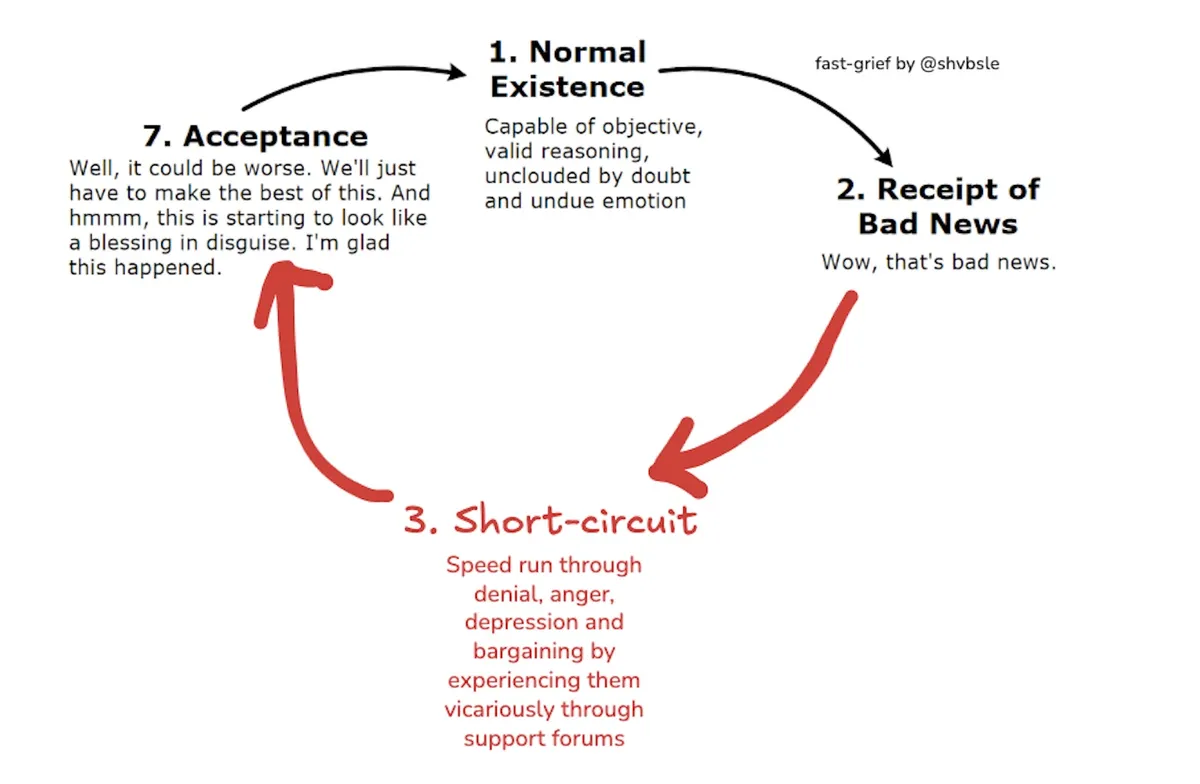
When you deeply accept your tragedy, the funniest thing happens: it is no longer a tragedy.
Bonus 1: Mechanistic Interpretation of Suffering
Disclaimer: Totally my thoughts, I'm no expert but I firmly believe in this:
- The brain maintains a constantly updating world model that encodes reality.
- You are at the center of this model.
- The brain runs simulations and produces possible future states of the model where you are happy(?).
- Some concepts are deeply integrated into your world-model. For example "you have a partner", "you have functioning limbs", "you are bound by the laws of physics"
- The brain assumes these concepts will continue to be true to be able to predict the next states of the world model.
- Losing any of these deeply integrated concepts, upon which several future simulations are built, results in an inconsistency in the world-model. Grief is an evolutionary mechanism to force you to reconcile this world model. Sometimes this mechanism can be abused; for example say you have a job interview coming up but you spend more time fantasizing about the life after you get the job rather than preparing for the job. You mess up the interview and are now sad because the dream shattered i.e. the world model is out of sync.
- I suspect that the following prescriptions for overcoming suffering are effective because:
- Live in the present: Prevents untrue simulations of the world-model
- Non-attachment: Prevents deeper integration of certain concepts into your world-model
- Samadhi or Nirvana: Disables the "ego" (ego-death) in the world-model.
Critique
The essay is open for critique. Drop me an email at shivbhosale97@gmail.com with subject: "essay critique" and I will add your points in this section. Also please point out any inaccuracies / mistakes / doubts in the essay.
- Shashank's critique on optimization: Shank views some steps in the essay as unnecessary and prefers skipping them as well. In his own words:
I want to do the processing of grief quickly (the similarities) but I don't want to do it again and again (the difference) - you talk about having a constant reminder to accept the tragedy while I say try to forget it if possible.
He writes more on his preferred strategy here: https://knhash.in/write-and-burn/
- Ritesh's critique on potential misinterpretation:
there's loads of people who would say that the rest of stages are suppressed
- Arnav's critique to further strengthen the essay:
- Clarify that Acceptance ≠ Surrender: Make it crystal clear that accepting reality doesn't mean accepting suffering as permanent.
- The "Why" question: Add a step about asking "Why was I doing what I was doing?" This helps people understand if they were attached to the outcome vs the process.
- Focus on the lesson, not the messenger: When suffering involves another person (breakup, betrayal), focus on what you learned, not on resenting them. This helps separate signal from noise.